 how-to
How to Protect Driveway from Dump Trailer: 7 Steps
Table of Contents
- How to Protect Driveway from Dump Trailer: What You Need
- Essential Gear for Driveway Protection
- Step 1: Assess Your Driveway's Condition and Weight Capacity
- Step 2: Choose the Right Driveway Protection Mats for Heavy Equipment
- Step 3: Protecting Concrete Driveway from Heavy Loads
- Step 4: Protecting Asphalt Driveway from Heavy Equipment
- Step 5: Proper Placement and Route Planning for the Dump Trailer
- Step 6: Safe Alternatives When Your Driveway Cannot Support the Trailer
- Step 7: Post-Delivery Inspection and Cleanup
- Frequently Asked Questions
Last Updated: October 14, 2026
How to Protect Driveway from Dump Trailer: What You Need
Learning how to protect driveway from dump trailer deliveries starts with one hard truth: a loaded dump trailer puts serious stress on concrete, asphalt, and gravel. At Fill and Dump Trailers, we rent driveway-safe 12-yard dump trailers, and the homeowners who avoid damage all do the same things before the wheels ever touch their property.
The good news? Most damage is preventable with cheap materials and smart placement.
Below, we'll show you exactly how to protect driveway from dump trailer traffic in seven steps. We'll cover weight limits, protection mats, placement, and what to do when your driveway simply can't handle the load.
Essential Gear for Driveway Protection
You don't need much, but the right gear makes a real difference. The mistake most homeowners make is buying protection materials by name instead of by specification. A "rubber mat" can mean anything from a 1/4-inch stall mat to a 1-inch composite ground mat, and the difference in load distribution is enormous.
Here's what actually matters when you're protecting a driveway from a loaded dump trailer.
Protection Materials by Specification
- Heavy-duty ground protection mats: Look for 1/2-inch to 1-inch thickness, a minimum 4 ft x 8 ft footprint per mat, and a rated capacity printed on the mat (many composite mats are rated for 60-120 psi ground pressure). These are the gold standard for soft ground and heavy axle loads.
- Rubber mats: 3/4-inch to 1-inch recycled rubber is the practical minimum. Thinner stall mats (3/8-inch) flex and telegraph point loads straight through to the slab.
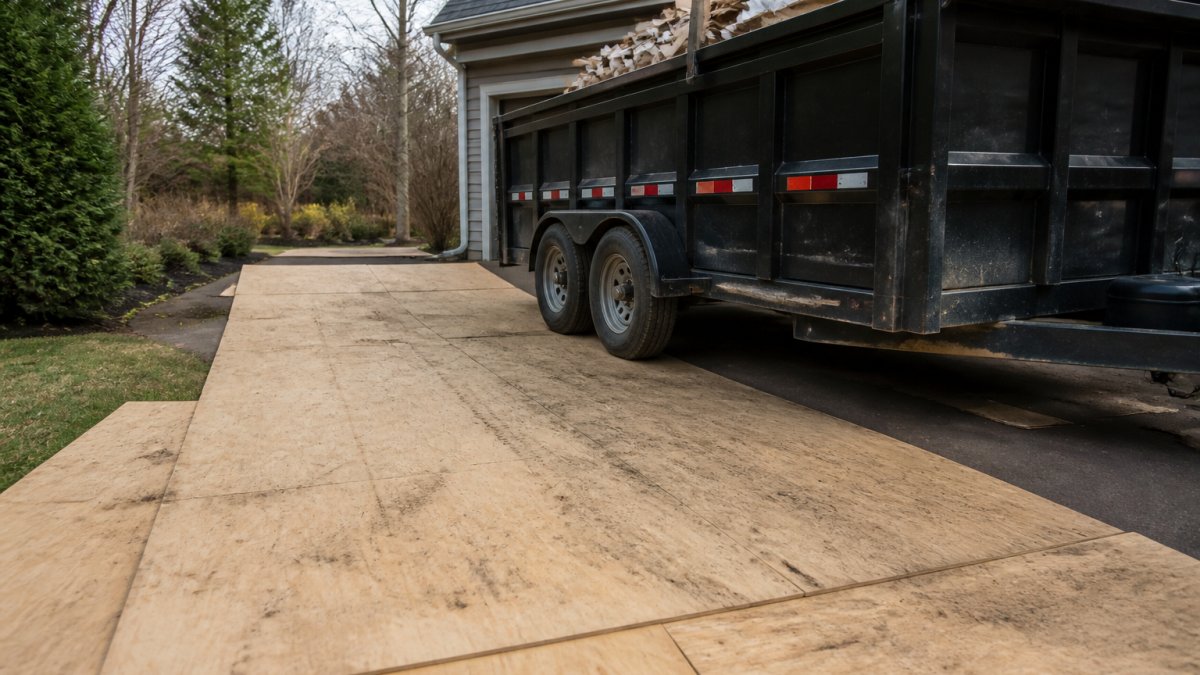
- 3/4-inch plywood: The budget layer. It works for a single light delivery on solid concrete, but it crushes and delaminates under repeated point loads. Use it as a second layer on top of mats, not as your only protection.
How Much Coverage Do You Actually Need?
Measure the trailer's footprint, then add a buffer. For a typical 12-yard dump trailer, plan for:
- Two mats under the axle tires (the heaviest point load)
- One mat under the tongue jack
- One mat under the rear of the bed where the pivot and dumped load land
That's four mats minimum for a single-axle trailer, six for a tandem-axle. Overlap seams so no seam sits directly under a tire or jack.
The Occupational Safety and Health Administration guidance on heavy equipment and ground conditions stresses stable, level ground for any loaded trailer. That principle applies to your driveway too, and the gear above is how you create it.
Step 1: Assess Your Driveway's Condition and Weight Capacity
Walk your driveway before you book anything. Look for existing cracks, soft spots, and settling near the edges.
How Much Weight Can a Driveway Hold? Key Factors
There's no single number, but these factors decide everything:
- Surface type: New concrete handles more than aged asphalt
- Thickness: 4-inch slabs flex under heavy point loads; 6-inch pours hold up better
- Base support: A compacted gravel base spreads weight; a thin one doesn't
- Age and existing damage: Old cracks get worse fast under load
A common mistake is judging capacity by the trailer's total weight alone. Axle load and ground pressure at each tire matter more.
Driveway Assessment Checklist
Use this before every delivery:
- Note every existing crack, chip, or settled area
- Check for soft spots after rain or snowmelt
- Measure driveway width and turning space
- Confirm slab thickness if you know it
Step 2: Choose the Right Driveway Protection Mats for Heavy Equipment
Driveway protection mats for heavy equipment are the single best investment you can make. They spread weight across a wider surface and keep tires and jacks from digging in.
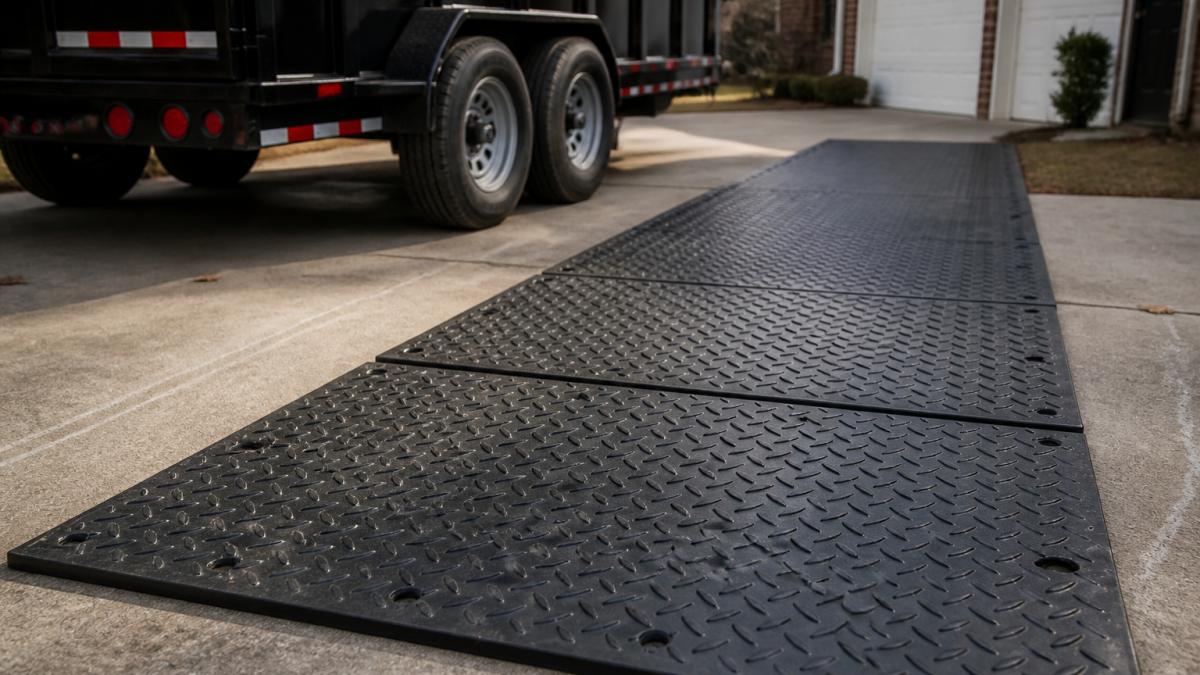
Plywood, Rubber Mats, or Composite Mats: Which Works Best?
| Material | Best For | Watch Out For |
|---|---|---|
| 3/4-inch plywood | Light loads, short-term use | Cracks under repeated point loads |
| Rubber mats | Most driveways, all surfaces | Heavier and pricier to buy |
| Composite mats | Very heavy loads, soft ground | Highest upfront cost |
Plywood is the budget option, but it flexes and splits. Rubber mats grip better and last through multiple projects. Composite mats win for the heaviest equipment on soft or wet ground.
Step 3: Protecting Concrete Driveway from Heavy Loads
Protecting concrete driveway from heavy loads comes down to three moves: spread the weight, keep loads off the edges, and never let a jack sit directly on the slab.
Concrete cracks when pressure concentrates in one spot. A loaded dump trailer puts hundreds of pounds through each tire contact patch.
Here's how to reduce that pressure:
- Place rubber mats or plywood under every wheel
- Put a wide board under the tongue jack
- Keep the trailer at least a foot back from the driveway edge
- Avoid parking where slabs meet, since joints are weak points
Newer concrete (under a year old) is more vulnerable. Give it extra protection or wait.
Step 4: Protecting Asphalt Driveway from Heavy Equipment
Protecting asphalt driveway from heavy equipment needs more care than concrete. Asphalt softens in heat and dents under steady point loads.
Timing matters. On a hot summer day, asphalt gives way faster than on a cool morning. Schedule delivery early if you can.
- Use wider mats to spread pressure
- Avoid parking in the same spot for the full loading period
- Keep the trailer off the edges, which crumble first
- Skip parking on freshly sealed asphalt for at least a month
Watch for rutting and denting after pickup. Small depressions often settle back, but deep ruts need repair.
Step 5: Proper Placement and Route Planning for the Dump Trailer
Plan the route before the trailer arrives. A driver who has to back up and reposition causes more damage than one clean approach. But with a dump trailer specifically, placement isn't just about where the tires sit, it's about where the bed pivots and where the load lands.
Why a Dump Trailer Is Different from a Dump Truck
Most driveway-protection advice online is written for dump trucks or stationary dumpsters. A dump trailer behaves differently in three ways that matter for your driveway:
- The pivot point is at the rear. When the bed tilts, the trailer's rear edge becomes a fulcrum. That concentrates the trailer's weight plus the load's weight onto a small strip of driveway at the back of the trailer, often the weakest, most edge-adjacent part of the slab.
- Axle placement shifts the load. On a single-axle dump trailer, the axle sits roughly at the midpoint, so the tongue jack carries a meaningful share of the load when the trailer is parked. On a tandem-axle, the load is spread but the rear axle still takes the brunt during dumping.
- Stabilizers or rear jacks may contact the ground. Many dump trailers have rear stabilizer legs that drop during dumping. If those legs land on unprotected concrete or asphalt, they punch point loads straight through.
Placement Rules for Dumping
- Aim the dump zone at the strongest part of the driveway. That usually means the middle of a slab, not near a joint, edge, or expansion strip.
- Keep the rear of the trailer at least 2 ft back from any edge. The pivot force during dumping is the single highest point load your driveway will see.
- Put a mat under the rear pivot area and under any stabilizer legs, not just under the tires.
- Dump onto a tarp or plywood landing zone if the material is heavy (gravel, dirt, concrete chunks). The falling load itself impacts the surface.
Managing Turning, Braking, and Unloading Forces
Turning and braking create sideways forces that tear up surfaces. Slow, straight approaches do the least harm. Ask the driver to avoid sharp steering inputs while the trailer is loaded, scrubbing a loaded tire across asphalt can leave a permanent scuff or rut.
Unloading is the riskiest moment. When the bed tilts, weight shifts hard onto the rear and the pivot point. That's where mats matter most.
Route Planning Checklist
- Mark the parking spot and dump zone with cones or chalk
- Clear the path of toys, hoses, and trash bins
- Confirm the driver knows the dump direction and where the load should land
- Walk the route with the driver if possible before they commit
Step 6: Safe Alternatives When Your Driveway Cannot Support the Trailer
Sometimes the smart move is keeping the trailer off the driveway entirely.
- Park on the street or a gravel pad and carry items out
- Use curbside pickup so the trailer never enters your driveway
- Build a temporary gravel ramp over weak spots
- Ask about a smaller trailer for lighter loads
At Fill and Dump Trailers, we offer curbside pickup for exactly this reason. If your driveway is old, steep, or narrow, we can collect your items at the curb instead. Our 12-yard trailers also include the first ton of disposal.
Step 7: Post-Delivery Inspection and Cleanup
Check your driveway the same day the trailer leaves. Early spotting saves money.
- Photograph any new cracks or dents
- Compare against your before photos
- Sweep up gravel, dirt, and debris
- Hose off oil stains before they set
Most surface marks are cosmetic. But if you find new cracking, document it right away and contact the rental company.
Frequently Asked Questions
How do I protect a concrete driveway from a dump trailer?
To protect a concrete driveway from a dump trailer, first assess the slab for existing cracks and determine its weight capacity. Place rigid protection mats or thick plywood along the entire path where the trailer will travel and park. Ensure the trailer's weight is distributed evenly across its axles, and avoid parking on edges or transitions. Keep the trailer stationary during loading and unloading to prevent surface damage.
What should I put under a dump trailer to protect my driveway?
Use heavy-duty rubber mats, composite mats, or 3/4-inch plywood under a dump trailer. These materials spread the load and prevent concentrated pressure from cracking or rutting the surface. For asphalt driveways, rubber mats are preferred because they conform to the surface and resist slipping. Always overlap mats and secure them to avoid movement during loading.
Can a dump trailer crack a driveway?
Yes, a dump trailer can crack a driveway if the weight exceeds the surface's load capacity or if the load is concentrated on a small area. Older concrete or asphalt with existing cracks is especially vulnerable. Using protection mats, limiting the load, and placing the trailer on stable ground reduces the risk. Always check with a professional if you are unsure about your driveway's strength.
How much weight can a residential driveway hold?
The total load a residential driveway can hold depends on slab thickness, base support, and age. Asphalt driveways generally support less weight. It's crucial to distribute the weight and use protection mats to avoid damage.
Your driveway doesn't have to be a casualty of your next cleanout. The right mats, smart placement, and a rental company that plans for surface protection make the difference between a smooth project and a repair bill. Fill and Dump Trailers offers driveway-safe 12-yard dump trailers, a three-day loading period, and curbside pickup when your driveway can't take the weight. Submit your request today and clear out your space without wrecking your concrete.