 blog
Towlos vs NeighborsTrailer: Rental Service Comparison
Table of Contents
- Towlos vs NeighborsTrailer: How the Two Trailer Rental Platforms Compare
- Feature Comparison: Towlos and NeighborsTrailer Side by Side
- How to Rent a Dump Trailer: Step-by-Step Process
- Dump Trailer Rental Cost: What Drives the Price
- Junk Removal vs Trailer Rental: Which Fits Your Cleanout?
- Insurance, Damage, and Renter Protection on Peer-to-Peer Platforms
- Which Trailer Rental Option Works Best for Your Project?
- Frequently Asked Questions
Last Updated: October 17, 2026
Towlos vs NeighborsTrailer: How the Two Trailer Rental Platforms Compare
Choosing between Towlos and NeighborsTrailer comes down to how each peer-to-peer marketplace handles trailer rental: both connect renters with owners who list equipment, but they differ in inventory mix, booking flow, and renter protection.
A peer-to-peer trailer rental marketplace lets owners list trailers for rent and renters book them directly, with the platform handling payments and agreements. That gives renters access to utility, enclosed, dump, car hauler, and flatbed trailers without buying one.
What Each Platform Offers
Both run on a peer-to-peer marketplace model but attract different listings. NeighborsTrailer built its name around neighbor-to-neighbor rentals: utility trailers, small enclosed trailers, and the occasional car hauler.
For a homeowner clearing a garage, nearby availability matters more. For a contractor hauling daily, the distinction matters a lot.
- Inventory mix: NeighborsTrailer leans residential; Towlos leans commercial.
- Booking process: Both use online booking with a rental agreement generated at checkout.
- Local pickup: Both depend on how many owners list trailers in your area.
Availability is the great equalizer: better inventory in theory is useless if nobody near you has listed a dump trailer this month.
Feature Comparison: Towlos and NeighborsTrailer Side by Side
The table below summarizes how the two platforms stack up on the factors renters ask about most. Where a platform does not publish a firm answer, the cell says so rather than guessing.
| Feature | Towlos | NeighborsTrailer |
|---|---|---|
| Marketplace model | Peer-to-peer, business-leaning | Peer-to-peer, neighbor-leaning |
| Typical inventory | Dump trailers, equipment trailers, car haulers | Utility, enclosed, and other light-duty trailers |
| Online booking | Yes | Yes |
| Rental agreement | Generated at booking | Generated at booking |
| Insurance options | Platform-arranged coverage options at checkout | Platform-arranged coverage options at checkout |
| Local pickup | Depends on owner listings | Depends on owner listings |
| Pricing | Set by individual owners | Set by individual owners |
| Communication | In-platform messaging | In-platform messaging |
| Fee structure | Not published as a flat rate; owners set rates and the platform takes a service fee from the transaction | Not published as a flat rate; owners set rates and the platform takes a service fee from the transaction |
| Geographic coverage | Availability varies by metro; dense in some markets, thin in others | Availability varies by metro; dense in some markets, thin in others |
| Cancellation terms | Set per listing | Set per listing |
| Damage claims | Handled through the platform's protection process | Handled through the platform's protection process |
| Support | In-platform messaging and email | In-platform messaging and email |
Neither platform publishes a flat rate, because owners set their own rates, flexibility for owners, variability for renters.
What the Table Cannot Tell You
A feature grid flattens the two services into the same shape, but three differences change what you pay and what you can rent:
- Inventory depth, not inventory type. Both list utility, enclosed, and dump trailers. The real question is how many are within a reasonable drive of your ZIP code on the day you need one.
- Fee transparency. Neither advertises a single all-in rate. Owners set the daily rate and the platform adds a service fee, so the listing number is not the checkout number. Budget for the service fee, delivery, and any protection plan.
- Protection terms. Both offer coverage at checkout, but terms are set per listing, not per platform. Two listings on the same site can have different damage and cancellation rules.
A Practical Eligibility Checklist
Before you book on either platform, confirm you can tow and return the trailer. Both leave this to the renter and neither refunds a booking you cannot legally or safely complete.
- Tow vehicle rating. Your tow rating must exceed the loaded trailer weight, not the empty weight. A 12-yard dump trailer can weigh several thousand pounds empty and much more loaded.
- Hitch and ball size. Confirm the listing's coupler size matches your ball mount and your receiver is rated for the tongue weight.
- Brake controller. Many loaded dump and equipment trailers require trailer brakes and a controller. Not every half-ton truck has one from the factory.
How Claims and Cancellations Typically Work
Neither platform publishes a uniform claims process, but the pattern is consistent across peer-to-peer marketplaces:
- Damage during rental. Report it through the platform before the rental window closes. Photos at pickup and return are the strongest evidence.
- Breakdowns. Contact the owner first through in-platform messaging, then platform support. Roadside assistance is usually the renter's responsibility.
- Late returns. Most listings charge by the day; late returns are billed at the daily rate plus an owner-set late fee.
Before you book on either platform, screenshot the listing's rate, fee breakdown, cancellation policy, and protection terms. That screenshot is your record if the final charge does not match what you agreed to.
How to Rent a Dump Trailer: Step-by-Step Process
Renting a dump trailer through a peer-to-peer platform follows a consistent sequence, whether you book on Towlos, NeighborsTrailer, or a local provider.
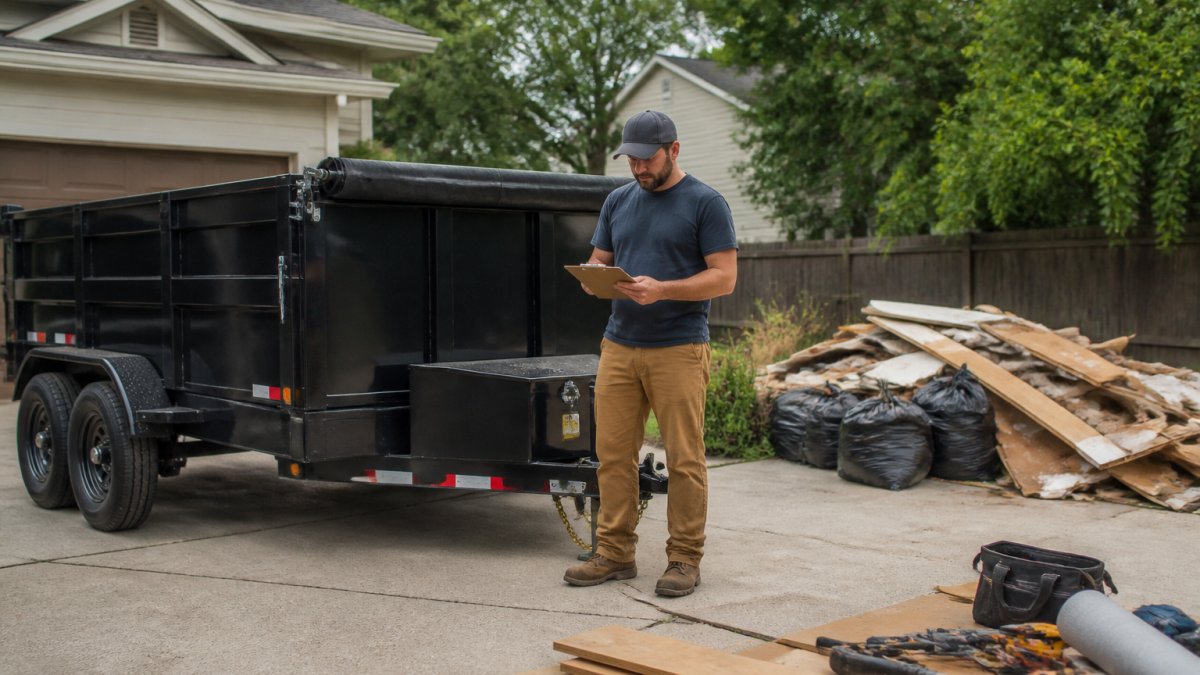
- Define the load. Estimate the volume and weight of your debris. A 12-yard dump trailer handles most garage, attic, and basement cleanouts.
- Check towing capacity. Confirm your vehicle's rating against the loaded trailer weight, and verify hitch compatibility before you commit.
- Search local inventory. Filter by trailer type, rental duration, and pickup location.
- Review the listing details. Read the rental agreement, insurance coverage, and return condition requirements.
- Book and confirm. Complete online booking, then message the owner to confirm pickup location and timing.
- Inspect before towing. Check tires, lights, hitch, and the dump mechanism before you leave.
- Return as agreed. Clean the trailer and return it in the condition specified, or you may owe a fee.
Photograph the trailer from every angle before you tow it. Timestamped photos protect you if the owner disputes the return condition later.
Dump Trailer Rental Cost: What Drives the Price
Dump trailer rental cost depends on four variables: rental duration, trailer size, delivery versus local pickup, and disposal fees. Most peer-to-peer listings charge by the day, with discounts for multi-day bookings.
The hidden line item is disposal. Many marketplace listings cover only the trailer, not what you put in it, so tipping fees at the landfill come out of your pocket.
The Four Cost Drivers, in Plain Terms
- Duration. Daily rates fall for longer rentals. A one-day rental is the most expensive way to rent per day; a three-day or weekly booking usually drops the effective daily rate.
- Size. Larger trailers cost more per day but cut the number of trips. A 12-yard dump trailer handles most garage, attic, and basement cleanouts in one load.
- Delivery vs. local pickup. Curbside pickup and delivery add convenience, and pricing depends on distance and timing. Local pickup from the owner's location is usually the cheapest option.
A Worked Example of the Real Total
Because owners set their own rates, no platform publishes a single price. But the shape of the total is predictable. Here is how the line items stack up for a typical one-day, 12-yard dump trailer rental:
| Line item | What it covers | How it is set |
|---|---|---|
| Daily rate | The trailer itself, for the rental window | Set by the owner, varies by listing and market |
| Platform service fee | The marketplace's cut of the transaction | Set by the platform, added at checkout |
| Delivery charge | Drop-off and pickup at your address | Set by the owner, based on distance and timing |
| Protection plan | Optional damage and liability coverage | Set by the platform, priced per rental |
| Disposal / tipping fee | What you put in the trailer | Set by the landfill or transfer station, by weight |
| Late fee | Returning after the agreed window | Set by the owner, usually the daily rate plus a penalty |
Two renters can book the same trailer on the same day and pay very different totals, because the disposal and delivery lines are the ones that swing the most.
Why Disposal Is the Line Item That Matters Most
A landfill or transfer station charges by weight, and construction debris, household junk, and yard waste all have different tipping rates. A single 12-yard load of mixed debris can easily run into the hundreds of dollars in tipping fees in many markets.
This is the practical difference between a marketplace rental and a service that bundles disposal. On a marketplace, you pay the owner for the trailer and the landfill for the waste.
How to Compare Two Quotes Fairly
When you have a marketplace listing and a bundled service quote side by side, normalize them before you decide:
- Add the service fee to the marketplace daily rate to get the true rental cost.
- Add the delivery charge if you are not picking up locally.
- Add the protection plan if you want damage coverage.
- Estimate the tipping fee based on the weight and type of your debris.
- Compare the totals, not the headline daily rates.
Most renters who do this math find that the cheapest-looking listing is rarely the cheapest total once disposal and delivery are included.
Junk Removal vs Trailer Rental: Which Fits Your Cleanout?
Junk removal versus trailer rental comes down to labor and pace. Junk removal crews haul everything away in one visit, but you pay for that labor.
Here is how the two compare in practice:
| Factor | Junk Removal | Trailer Rental |
|---|---|---|
| Who loads | Crew | You |
| Scheduling | One appointment | Flexible loading window |
| Cost driver | Volume and labor | Rental duration and disposal |
| Best for | Heavy, bulky, single-day jobs | Multi-day cleanouts and DIY projects |
For a property manager handling tenant move-outs, the flexible loading window of a trailer rental often wins.
That is where our approach helps. Fill and Dump Trailers offers a three-day loading period and curbside pickup, so you are not racing a crew through your garage in a single afternoon.
Insurance, Damage, and Renter Protection on Peer-to-Peer Platforms
Insurance coverage on peer-to-peer platforms is not automatic, and it is rarely identical between listings. Most platforms offer optional protection plans at checkout, while your personal auto policy may cover a rented trailer only in limited situations.
Never assume a peer-to-peer rental includes damage protection. Confirm what the platform covers, what your own policy covers, and what gap remains before you tow.
Three things to verify before booking:
- Liability: Who pays if the trailer damages property in transit?
- Damage: What counts as normal wear versus chargeable damage?
- Cancellation: What refund do you get if plans change?
For regulatory guidance on towing safety and equipment requirements, the Federal Motor Carrier Safety Administration publishes rules that apply to commercial towing operations. Renters moving household goods should also check their state's trailer registration and weight limits through their state motor vehicle agency.
Which Trailer Rental Option Works Best for Your Project?
The right choice depends on your load, your vehicle, and your timeline. Towlos suits renters who need heavier equipment and business-grade inventory.
For cleanouts specifically, the deciding factor is usually disposal, not the trailer itself.
That is the gap Fill and Dump Trailers was built to close.
Pricing depends on your project details, so submit a request for a quote.
Frequently Asked Questions
How does peer-to-peer trailer rental work?
Peer-to-peer platforms like Towlos and NeighborsTrailer connect trailer owners with renters through an online marketplace. Owners list their available inventory, set rental rates, and renters book through the platform. You pick up the trailer locally, use it for the agreed rental duration, and return it in the same condition. The platform handles payment processing and may offer limited rental protection. Availability depends entirely on what owners in your area have listed, so selection varies by location.
Are dump trailers included on Towlos or NeighborsTrailer?
Peer-to-peer marketplaces list whatever owners choose to post, so dump trailer availability varies by market and changes frequently. You may find utility trailers, enclosed trailers, car haulers, and flatbed trailers more often than dump trailers. If you need a dump trailer specifically for a cleanout, a dedicated local dump trailer rental service guarantees the equipment, includes disposal, and handles delivery and pickup, which removes the uncertainty of searching a marketplace for a specific trailer type.
Is it cheaper to rent a trailer or hire a junk removal service?
The answer depends on volume and labor. Junk removal services charge for the full job including loading, hauling, and disposal, which works well for small or one-time pickups. Renting a dump trailer typically costs less per ton of debris because you control the loading pace and avoid per-item fees. For large cleanouts like attic, garage, or basement projects, trailer rental often delivers better value. Request a quote from your local provider to compare against a junk removal estimate.
What are the rental requirements for peer-to-peer trailer platforms?
Most peer-to-peer platforms require a valid driver's license, a vehicle with sufficient towing capacity, and a properly rated hitch. Some platforms set minimum age requirements and may ask for proof of insurance. You are responsible for safe towing, securing the load, and returning the trailer in the condition you received it. Check hitch compatibility and towing capacity before booking, since not every vehicle can safely pull every trailer size.
Sorting through peer-to-peer listings, towing limits, and disposal fees takes time most cleanouts do not have. Fill and Dump Trailers removes that guesswork with driveway-safe 12-yard dump trailers, a three-day loading period, and the first ton of waste disposal included in every rental. Submit a request today and get a trailer delivered, loaded at your pace, and hauled away on schedule.