 how-to
How to Calculate Waste for Rental: A Step-by-Step Guide
Table of Contents
- Why Calculating Waste Accurately Matters for Your Rental
- Step 1: Assess Your Project Scope and Inventory
- Step 2: Estimating Waste from a Home Cleanout
- Step 3: Understanding How Much Does a Cubic Yard of Debris Weigh
- Step 4: Using a Dumpster Rental Size Calculator
- Step 5: Checking Dumpster Rental Weight Limits and Overage Costs
- Common Mistakes to Avoid When Calculating Rental Waste
- Conclusion
- Frequently Asked Questions
Last Updated: October 19, 2026
Why Calculating Waste Accurately Matters for Your Rental
Learning how to calculate waste for rental saves money and headaches. When you underestimate, you'll either overfill your dumpster or face surprise overage fees. When you overestimate, you pay for capacity you don't use. The goal is simple: match your actual waste volume to the right container size.
Most people guess. They eyeball their garage, think "that looks like a lot," and rent something too big or too small. The better approach is systematic.
This guide walks you through how to calculate waste for rental in five concrete steps. You'll learn to assess what you're actually disposing of, estimate volume and weight separately, and avoid the most common mistakes that lead to extra costs. By the end, you'll know exactly what size container fits your project.
Step 1: Assess Your Project Scope and Inventory
Start by listing everything you plan to dispose of. Don't estimate yet, just catalog it.
Walk through your space and write down item categories. Are you clearing an attic? List boxes, old furniture, storage bins, clothing, books. Doing a basement cleanout? Note water heaters, old appliances, broken tools, paint cans. Renovation debris? Document drywall, wood framing, tile, insulation, flooring.
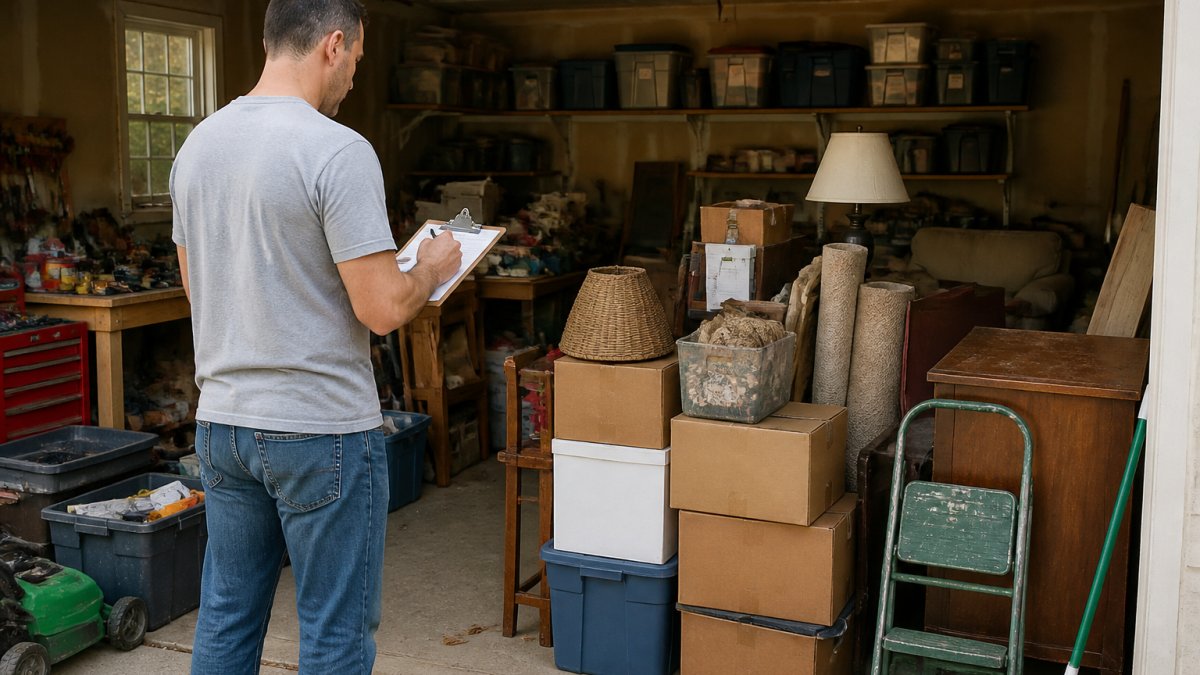
The inventory step matters because different materials weigh differently. A box of books is heavier than a box of clothing. Appliances are denser than drywall. You need to know what's going in so you can estimate weight accurately later.
Create a simple list:
- Large furniture pieces (count them)
- Appliances (list type and quantity)
- Boxes and bags (estimate number)
- Loose items (old tools, sporting equipment, etc.)
- Construction or demolition debris (by material type)
- Yard waste or landscaping debris
This inventory becomes your baseline for estimating both volume and weight.
Step 2: Estimating Waste from a Home Cleanout
Home cleanouts are the most common reason people rent dumpsters, but most guides stop at vague room ranges. A transparent method beats eyeballing every time.
Worked example, one-car garage cleanout. A typical one-car garage is about 12 ft × 20 ft = 240 sq ft.
Room-by-room baseline (normal residential clutter):
- One bedroom or small office: 1-2 cubic yards
- One-car garage: 3-6 cubic yards (up to 10+ if packed floor-to-ceiling)
- Attic: 4-8 cubic yards
- Full basement: 6-12 cubic yards
- Whole-house estate cleanout: 12-20+ cubic yards
These assume furniture, boxes, clothing, and general household items. Add 20-30% if heavy appliances or construction debris are mixed in.
Rental-property angle: estimate by unit count, occupancy, and turnover. For landlords and property managers, waste is recurring, not one-time. A practical estimator:
- Unit turnover (standard): 1-2 cubic yards per unit for a typical apartment or small rental house turnover (tenant left normal furnishings and trash).
- Unit turnover (heavy/abandoned): 3-5 cubic yards per unit when furniture and appliances are left behind.
- Occupied annual accumulation: roughly 0.5-1 cubic yard per occupant per year for routine decluttering and minor repairs.
- Multi-unit portfolio: multiply per-unit estimates by unit count, then add 10-15% for shared areas (hallways, storage, common rooms).
Worked example, four-unit turnover. Four standard turnovers at 1.5 cubic yards each = 6 cubic yards, plus 10% shared-area buffer = about 6.6 cubic yards.
Uncertainty ranges. Never present a single number as precise. Give a low, typical, and high estimate. For the garage example: low 8 cubic yards (lightly cluttered), typical 10-11, high 14+ (floor-to-ceiling, heavy items).
The inventory from Step 1 becomes your baseline: count large items, note appliances, and flag heavy materials so the volume estimate can be converted to weight in Step 3.
Step 3: Understanding How Much Does a Cubic Yard of Debris Weigh
Weight and volume are separate calculations. A cubic yard of feathers weighs far less than a cubic yard of bricks. For waste disposal, you need both numbers because dumpster rental weight limits matter.
A cubic yard is 3 feet by 3 feet by 3 feet, 27 cubic feet total. What that weighs depends entirely on what's in it.
Common waste materials and their approximate weights per cubic yard:
- General household items and mixed debris: 400-600 pounds
- Cardboard boxes (empty or lightly packed): 100-200 pounds
- Clothing and textiles: 200-300 pounds
- Books and paper: 600-800 pounds
- Wood furniture: 500-1000 pounds
- Drywall and construction debris: 800-1200 pounds
- Concrete or masonry: 1500-2000 pounds
- Yard waste (loose): 200-400 pounds
Your waste is probably a mix. A typical home cleanout with furniture, boxes, and miscellaneous items averages around 500-700 pounds per cubic yard.
If you're clearing an attic with mostly boxes and lightweight items, you might be at 300-400 pounds per cubic yard. If you're removing old appliances, heavy furniture, or demolition debris, you could hit 1000+ pounds per cubic yard.
Step 4: Using a Dumpster Rental Size Calculator
A dumpster rental size calculator helps you convert your inventory into a specific container recommendation.
Here's how to use one effectively:
- Input your cubic yard estimate from Step 2
- Select your primary waste type (household, construction, mixed)
- Enter the weight estimate based on Step 3
- The calculator suggests a container size
Most calculators recommend container sizes in increments: 10-yard, 15-yard, 20-yard, and so on. Fill and Dump Trailers offers 12-yard dump trailers, which works well for most household cleanouts and moderate renovation projects.
The calculator's job is to match volume and weight to a container that won't be undersized or wastefully oversized. A 12-yard trailer holds roughly 12 cubic yards of material and typically includes capacity for the first ton of waste in the rental price.
If your estimate is 8 cubic yards and 4000 pounds, a 12-yard trailer gives you comfortable headroom without excess space. If you're at 14 cubic yards, you'd need something larger.
Use the calculator as a guide, not gospel. If you're uncertain, round up slightly. It's better to have extra space than to run out halfway through loading.
Step 5: Checking Dumpster Rental Weight Limits and Overage Costs
The mechanism. Most standard residential rentals include the first ton (2,000 pounds) of waste. Your bill has two meters running: cubic yards filled and pounds disposed. Whichever limit you hit first determines whether you pay overage.
Worked example, volume fine, weight over. Suppose your estimate is 8 cubic yards of mixed debris at roughly 500 pounds per cubic yard = 4,000 pounds. The container holds 12 cubic yards, so volume is comfortable.
Worked example, weight fine, volume over. A garage of cardboard, clothing, and light furniture at 300 pounds per cubic yard and 14 cubic yards = 4,200 pounds. Weight is over the ton allowance, and volume exceeds a 12-yard trailer. Here you need both a larger container and a tonnage plan.
Build uncertainty into the weight estimate. Use low, typical, and high density figures rather than one number:
- Light mixed household (boxes, clothing, light furniture): 300-400 lb/cu yd
- Typical mixed cleanout: 500-700 lb/cu yd
- Heavy debris (appliances, tile, drywall): 800-1,200 lb/cu yd
- Concrete, masonry, dirt: 1,500-2,000+ lb/cu yd
Multiply your volume estimate by the low and high density figures to get a weight range. If the high end exceeds the included tonnage, plan for overage or upgrade the tonnage tier before you load.
Adjustment factors that shift weight:
- Hidden debris: items behind walls, under stairs, or in crawl spaces add volume and weight you didn't inventory.
- Moisture: wet drywall, soaked carpet, or yard waste can add hundreds of pounds.
- Packing efficiency: tightly stacked dense items increase weight per cubic yard; loose bulky items decrease it.
- Mixed loads: one refrigerator or washer adds roughly 200-300 pounds; a few appliances can push a light load into overage territory.
How to avoid surprises:
- Estimate weight as a range, not a single number.
- Confirm the included tonnage in your rental agreement before loading.
- Ask your rental company for the overage rate per ton upfront.
- If your high-end weight estimate is borderline, upgrade to the next tonnage tier or schedule a second haul.
- Keep dense materials (concrete, dirt, masonry) in a separate load or container sized for weight, not volume.
Fill and Dump Trailers includes the first ton in every 12-yard rental, which covers most household cleanouts. For projects with heavy materials, clarify overage pricing before you commit so the final bill matches your estimate.
Common Mistakes to Avoid When Calculating Rental Waste
Most miscalculations come from overlooking one of these traps.
Underestimating volume. People systematically underestimate how much space their stuff actually takes up. That "small" pile of boxes fills more cubic yards than you'd guess.
Forgetting about density. A cubic yard of books weighs twice as much as a cubic yard of clothing.
Mixing material types without adjusting. A cleanout with mostly household items plus a few old appliances shifts the weight significantly.
Not accounting for how items pack. Loose items (yard waste, demolition debris) take up more space than the same material packed tightly. Boxes of items compress less than loose objects.
Ignoring local waste regulations. Some materials can't go in standard dumpsters, batteries, paint, certain chemicals, large appliances. Check what's restricted in your area before you load.
Assuming all rental companies are the same. Included tonnage, overage fees, and container sizes vary. Get a quote from your rental company with your specific waste estimate. Don't guess at pricing.
Conclusion
Calculating waste for rental accurately comes down to three steps: inventory what you're disposing of, estimate volume and weight separately, and match those numbers to the right container size. Most people skip the inventory step and pay for it with either overfilled containers or surprise overage fees.
Fill and Dump Trailers simplifies this process with 12-yard dump trailers that include the first ton of waste disposal. Our flexible three-day loading period gives you time to work at your own pace, and we handle delivery and pickup so you can focus on the project. If you'd prefer not to load heavy items yourself, we offer curbside pickup service as well.
Get started with Fill and Dump Trailers and handle your cleanout without guesswork. Submit a request with your estimated waste volume and material type, and we'll confirm pricing and schedule your rental.
Frequently Asked Questions
How do I estimate how much waste I need to dispose of?
Start by inventorying items by category: furniture, appliances, construction debris, yard waste. Measure room dimensions in square footage and estimate how full you'll load the trailer. For household cleanouts, multiply square footage by 0.5 to 1 cubic yard per 100 square feet. For construction debris, weigh material samples or use density estimates: drywall averages 50 pounds per cubic yard, lumber 400-600 pounds per cubic yard. Document everything to cross-check your volume and weight estimates before rental.
How much does a cubic yard of debris weigh?
Weight varies by material type. General estimates: mixed household items (furniture, boxes) 300-500 pounds per cubic yard; drywall and plaster 500-700 pounds; wood and lumber 400-600 pounds; concrete and brick 1,200-1,500 pounds; metal 800-1,000 pounds. Wet or compacted materials weigh more. Calculate total weight by multiplying your cubic yard estimate by the density of your primary waste type, then add 10-15% for uncertainty. This helps you stay within dumpster rental weight limits and avoid overage fees.
What is included in the first ton of waste disposal with a rental?
Most rental services, including Fill and Dump Trailers, include the first ton (2,000 pounds) of disposal in the rental price. This covers your initial load. If you exceed that weight limit, you'll typically pay an overage fee per additional ton. Always confirm the included tonnage and overage rate before scheduling your rental so you can budget accurately and avoid surprise charges at pickup.
How do I know if I need to extend my rental period or make multiple trips?
Calculate total volume and weight, then compare to your rental's capacity and your loading timeline. A three-day loading period works well for most household cleanouts and renovation projects. If you have more debris than capacity, you can request an extension (confirm extra-day pricing in advance) or schedule a second rental. For property managers handling multiple units, plan one rental per 3-5 tenant move-outs or schedule sequential rentals to avoid idle time and manage costs.